Tarek
Elgawhary

In his personal library

Coexist Prize — New York University
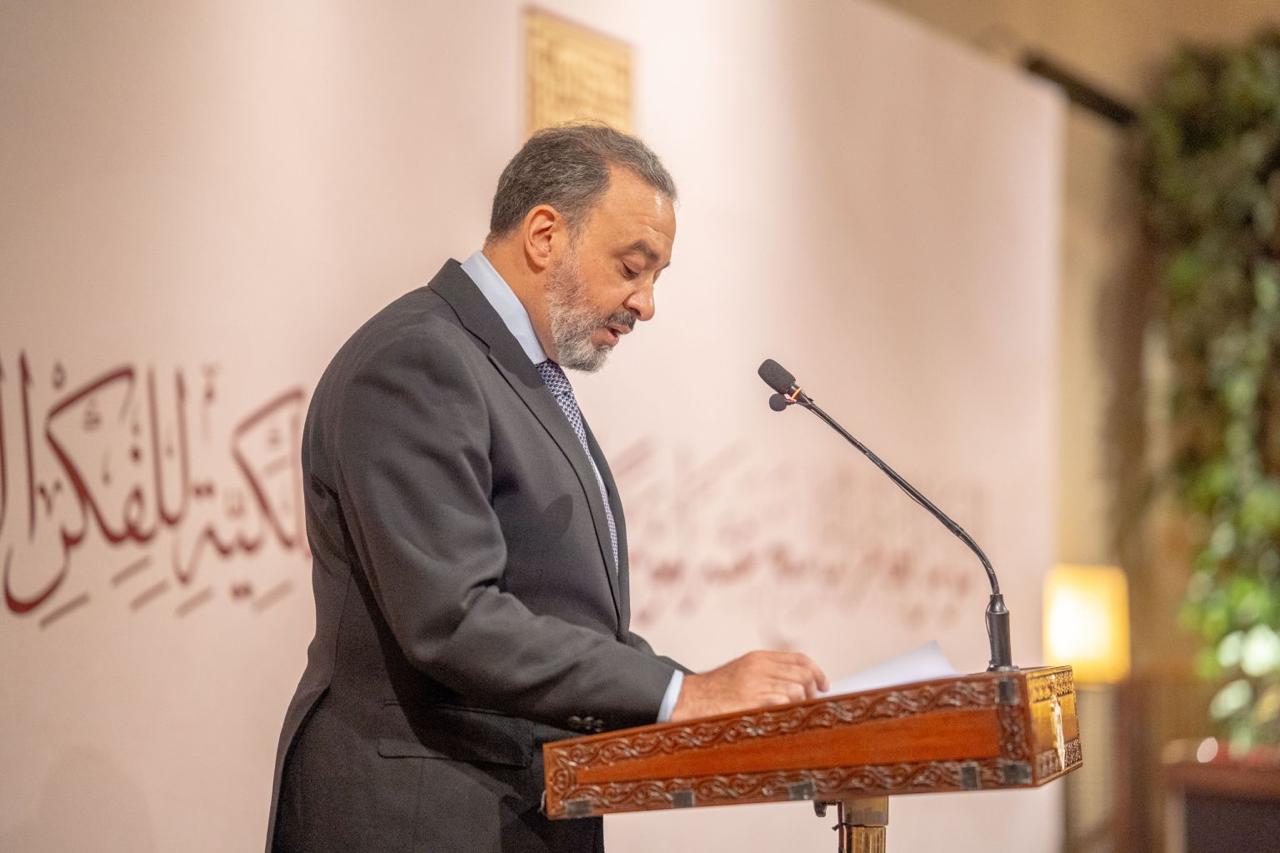
Addressing HRH Prince Hussein bin Abdullah, the Crown Prince of Jordan
Scholar · Author · Educator · Entrepreneur · Philanthropist
Academic Formation
Dr. Elgawhary holds a BA in Comparative Religions (Jewish Studies focus) and an MA in Islam and Hinduism from George Washington University. He completed his PhD in Islamic Law at Princeton University — subsequently published as Rewriting Islamic Law (Gorgias Press, 2019).
Traditional Training
Between 2003–2007, Dr. Elgawhary studied and received his ijāza in the classical Islamic sciences and fatwa at al-Azhar Seminary, Cairo. His primary teacher is Shaykh ʿAlī Jumʿa, the former Grand Mufti of Egypt, with whom he has studied fiqh, uṣūl al-fiqh, and taṣawwuf for over twenty years.
Spiritual Authority
Dr. Elgawhary received his spiritual training under Shaykh Ali Gomaa and was licensed in the Shadhili Sufi Order to guide disciples and pass on the spiritual path to others.
Community & Public Roles
President of the Coexist Foundation. Founder & CEO of Bayt al-Fatwa. President Coexist Research International. Resident Scholar at the Islamic Community Center of Potomac (ICCP). Has appeared at the Hudson Institute, New York University, and international forums.
Early Life and Formation
Tarek Asem Elgawhary is an American Muslim scholar of Egyptian heritage whose intellectual formation spans two of the most rigorous traditions of Islamic and Western academic learning. Born and raised in the United States, he developed an early and abiding interest in religion, comparative thought, and the relationship between revealed traditions and the challenges of modern life — a preoccupation that would shape every dimension of his career.
Academic Education
Dr. Elgawhary pursued his undergraduate and graduate studies at the George Washington University in Washington, D.C., where he earned a Bachelor of Arts in Comparative Religions with a focus on Jewish Studies, followed by a Master of Arts in a specialized interdisciplinary program concentrating on Islam and Hinduism. This cross-traditional formation gave him an unusually broad foundation — one that would inform his later work in interfaith dialogue, coexistence, and the comparative study of legal and spiritual traditions.
He then pursued doctoral studies at Princeton University, one of the preeminent centers of Islamic studies in the Western academy, where he completed his PhD in Islamic Law. His dissertation, titled "Restructuring Islamic Law: The Opinions of the ʿUlamāʾ towards Codification of Personal Status Law in Egypt," examined the intersection of Islamic jurisprudence and modern state-building in Egypt — scrutinizing the underlying logic of codification, its implications for personal status laws, and the contextual relationship between religious scholars and political authorities in Egypt at the end of the nineteenth century.
Traditional Islamic Training
Alongside his Western academic credentials, Dr. Elgawhary underwent a rigorous traditional formation in the classical Islamic sciences. He was trained at the al-Azhar Seminary in Cairo, Egypt between 2003 and 2007, where he studied and was licensed (ijāza) in the traditional Islamic sciences.
Central to his traditional formation is his relationship with Shaykh ʿAlī Gomaa Muḥammad ʿAbd al-Wahhāb, the former Grand Mufti of Egypt. In Dr. Elgawhary's own words:
"I am honored that I received my spiritual training and guidance from the saintly and learned Shaykh ʿAlī Jumʿa. I studied Islamic law (fiqh) and legal theory (uṣūl al-fiqh) with him as well as the discipline of taṣawwuf, and I have been his companion for over twenty years."
This dual formation — a PhD from Princeton and an ijāza from al-Azhar — places Dr. Elgawhary in a rare category of scholars equally at home in the classical tradition and the modern academy.
Scholarly and Teaching Career
Throughout his career, Dr. Elgawhary has taught courses in Islamic Legal Theory (Uṣūl al-Fiqh) and Islamic Law (Fiqh) at various institutions, including the Madina Institute and eMadina. He has lectured widely across the United States and internationally, bridging the gap between traditional Islamic scholarship and contemporary audiences.
His academic work has been cited in peer-reviewed journals and scholarly publications on Islamic law, Egyptian legal history, and the relationship between religion and the modern state. His Princeton dissertation was subsequently published as Rewriting Islamic Law: The Opinions of the ʿUlamāʾ towards Codification of Personal Status Law in Egypt (Gorgias Press, 2019), establishing him as a scholarly authority on the intersection of Islamic jurisprudence and modern legal reform.
Published Works
Books
- Abdullah bin Siddiq al-Ghumari: A Biography (Making Sense of Islam, 2025)
- Gate to Madina (Making Sense of Islam, 2025)
- In Search of Mindfulness (Making Sense of Islam, 2025)
- Daily Contemplations Journal (Chronicle Books, 2023)
- The Aphorisms of Ibn 'AtaAllah (Making Sense of Islam, 2022)
- Invocations of the Siddīqiyya-Shādhiliyya Order (Making Sense of Islam, 2020)
- Restructuring Islamic Law (Gorgias Press, 2019)
- Responding from the Tradition (Fons Vitae, 2011)
Articles
- “A Muslim Perspective on Masturbation”
- “A Selected Survey of the Muslim World” — The Muslim 500 2023, Royal Islamic Strategic Studies Centre, 2022
- “A Selected Survey of the Muslim World” — The Muslim 500 2022, Royal Islamic Strategic Studies Centre, 2021
- “A Selected Survey of the Muslim World” — The Muslim 500 2021, Royal Islamic Strategic Studies Centre, 2020
- “Conflicting Currents in Egyptian Thought” — Current Trends in Islamic Thought, Hudson Institute, Vol 24, July 2019
- “Codification of Islamic Law” — The Oxford Encyclopedia of Islam and Law, 2013
- “Being Where God Placed Us” — Islamic Horizons, July/August 2013